Squarespace recently added native support for llms.txt on version 7.1 websites, allowing site owners to publish a Markdown file at /llms.txt without uploads or redirects.
Supporting the emerging format is reasonable. But Squarespace’s user interface overstates what the file can do, implying that it will influence how AI systems understand, summarize, and cite a website. This article explains what llms.txt actually does, where Squarespace’s wording goes too far, and whether sites should use it.
Do You Need llms.txt on Squarespace?
For most Squarespace websites, llms.txt is optional. There is no reliable evidence that adding it improves search rankings, AI citations, or how major AI platforms represent a site. Some documentation tools and AI workflows support the format, but that does not establish a benefit for the average Squarespace website.
Current Evidence at a Glance
What Is llms.txt?
llms.txt is a proposed Markdown format to give AI applications a concise overview of a website and links to important resources. A file may include the site or project name, a summary, explanatory notes, and organized links to key pages.
Its intended use is primarily at inference time: an AI application that already knows about the file may retrieve it and use the linked resources as context. The proposal does not require AI systems to look for /llms.txt, specify how they must use it, or establish it as a broadly supported AI visibility standard.
What Squarespace Added
Squarespace made it easier to publish an llms.txt file in the conventional location. Previously, users who wanted to experiment with the format had to upload a file and create a URL redirect to its hosted storage location. Native support removes that workaround for Squarespace 7.1 sites, while users on 7.0 can follow this guide.
The setting appears under: SEO/AI Visibility → SEO Settings → llms.txt
The plain Markdown file is published here: https://example.com/llms.txt
Google Does Not Use llms.txt as a Special Signal
Google says websites do not need AI-specific text files, Markdown files, or new machine-readable formats to appear in Search or its generative features. Google may crawl an accessible llms.txt file as an ordinary text resource, but it does not treat the file as a special discovery, ranking, or eligibility signal for standard Search, AI Overviews, AI Mode, or other generative Search features.
Google’s documentation actually lists llms.txt under the heading: “Mythbusting generative AI search: what you don't need to do.” They clarify that maintaining such a file for another service will neither positively nor negatively affect visibility or rankings in Google Search.
In terms of generative engine optimization (GEO), Google’s guidance is the same as SEO: make your pages accessible, useful, well organized, and eligible for normal indexing.
Related: Google’s Search Off the Record: Should I use markdown for my site?
What About ChatGPT?
OpenAI does not instruct publishers to create an llms.txt file for ChatGPT Search. Its publisher guidance focuses on crawler access rather than AI-specific summary files.
ChatGPT can retrieve an accessible llms.txt URL like any other public text resource, but OpenAI has not documented routine discovery of /llms.txt files or identified them as a citation signal. Accessible, accurate, and authoritative website pages are far more important than an experimental summary file.
What About Claude?
Anthropic uses llms.txt for its own documentation and identifies it as an LLM-optimized documentation index. Some Anthropic documentation also directs compatible agents to use the file to discover available pages.
However, Anthropic’s guidance for general website owners focuses on controlling crawler access. It does not say that publishing an llms.txt file will improve citations or control how Claude represents a website. Its use in specific documentation workflows is not evidence that Claude routinely checks /llms.txt across the web.
Where Squarespace’s Description Overreaches
The Squarespace interface uses statements that imply that publishing an llms.txt file will influence how major AI systems understand, summarize, and cite your website. But that level of adoption and control has not been established.
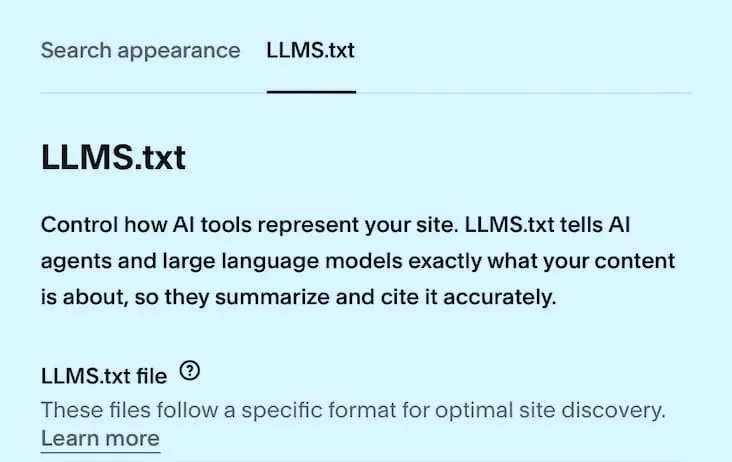
“Control How AI Tools Represent Your Site”
Squarespace’s most significant overreach is the word control. A site owner controls what appears in the file—not how an independent AI system represents the site.
AI-generated answers draw on many sources beyond your website, including search indexes, reviews, directories, news coverage, and other public information. An AI system may ignore your llms.txt file, use conflicting information, or still summarize the business incorrectly. Squarespace cannot control AI systems or guarantee their output.
More accurate wording would be: Publish an optional site overview that compatible AI tools may use.
“Exactly What Your Content Is About”
The word exactly is similarly unsupported. An llms.txt file contains the site owner’s description, which might be selective, outdated, inaccurate, or promotional. It is self-published information, not an independently verified interpretation.
The file could be useful for identifying important resources, but it cannot dictate an AI system’s conclusions. Otherwise, any business could declare itself the leading authority in its field and expect external systems to accept the claim.
A familiar example is the meta description. A site owner can write one, but Google usually replaces it with different text because another passage better answers the search. An llms.txt summary is also self-published context, not an instruction that an outside system must follow.
“So They Summarize and Cite It Accurately”
Publishing the file does not guarantee accurate summaries or citations. An AI system would still need to discover the file, retrieve it, consider it relevant, follow its links, select the underlying pages for a particular answer, summarize them correctly, and choose to cite the website.
Squarespace’s wording compresses that uncertain process into a misleading implication: Publish llms.txt → AI understands the site → AI summarizes it accurately → AI cites it
No evidence shows that this sequence occurs consistently across major AI platforms.
It Is Not an “AI Sitemap”
Squarespace’s documentation compares llms.txt to a sitemap. The analogy may help beginners understand that the file contains links, but it creates the wrong expectation.
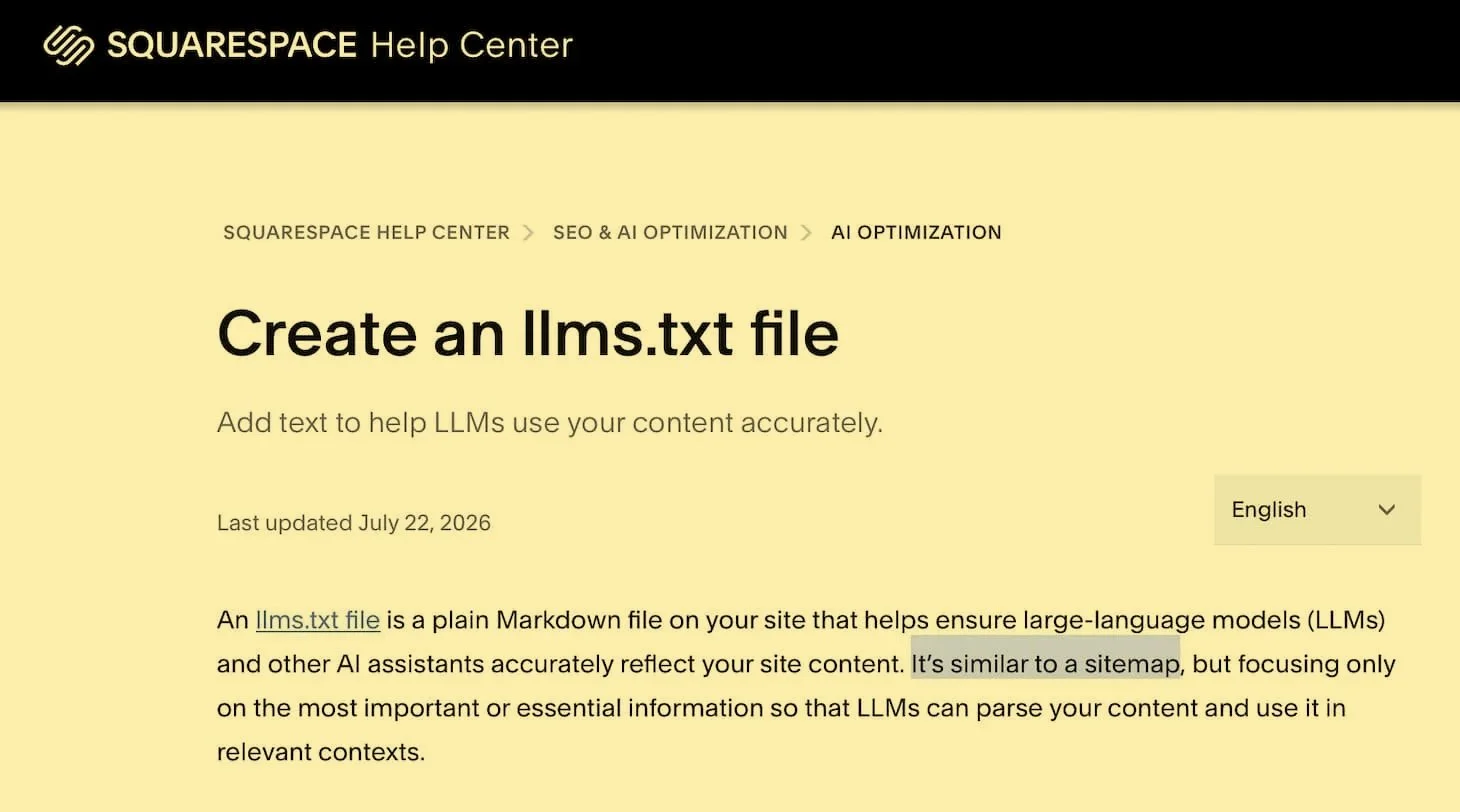
XML sitemaps operate through mature search engine protocols. Major search engines document how they discover, submit, and process them. No comparable universal protocol currently exists for llms.txt. It is better understood as a curated guide that compatible agents may choose to use—not an AI equivalent of an XML sitemap.
The Unsupported 2,000-Character Recommendation
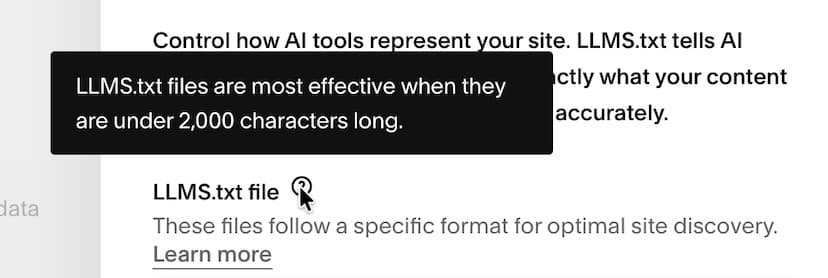
Squarespace says llms.txt files are “most effective” when they contain fewer than 2,000 characters, but it does not explain the basis for that threshold.
The original llms.txt proposal recommends concise, organized content but does not establish a 2,000-character limit. Nor is that threshold documented by Google, OpenAI, Anthropic, or another major platform.
Calling the limit “most effective” implies that Squarespace has measured an outcome such as retrieval, parsing, citation frequency, or answer accuracy. Unless Squarespace provides that evidence, a better recommendation is: Keep the file concise, factual, and focused on your most important resources.
When Is llms.txt Worth Adding?
An llms.txt file is most plausible for sites with large, structured collections of information, such as:
Developer documentation and technical reference libraries
Research repositories and large knowledge bases
Educational resource collections
Custom AI or agent workflows that explicitly support the format
The case is much weaker for a typical small business website with a homepage, About page, service pages, and contact information. In our work with SMB sites, none has needed an llms.txt file to appear in traditional search or AI-generated answers. The file is not required for visibility.
Adding a short, accurate file is a reasonable low-effort experiment and could become more useful if adoption grows. But it is not a required optimization step and should not take priority over improving the website itself, maintaining accurate business information, or earning credible references.
Risks and Limitations of llms.txt
Outdated information: A manually maintained file can become inaccurate as services, staff, locations, policies, and URLs change.
Unsupported or poorly structured content: Promotional claims, keyword lists, or vague summaries will make the file misleading or unhelpful.
Misplaced priorities: The main strategic risk is false confidence. llms.txt cannot repair a weak site. A business owner may spend time refining an experimental summary file while leaving more consequential problems unresolved.
Unnecessary upselling: Placement inside the SEO/AI Visibility panel makes it easy for designers or SEO providers to present llms.txt creation as a required AI-search service rather than an optional experiment.
Unclear ownership: A designer may create the file without explaining that it requires maintenance, leaving site owners unaware that it exists or who is responsible for updating it. Anyone who publishes one should assign ownership and review it whenever the business changes, with an annual check as a backstop.
No platform reporting: Squarespace provides no reporting showing whether recognised AI crawlers ever request your llms.txt file. There is no built-in way to tell whether the file is being used, leaving users to assume the feature is providing value without evidence.
What Users Are Likely to Infer
Placement inside Squarespace’s SEO/AI Visibility panel, combined with the current wording, will lead users to assume that:
llms.txt is an established optimization feature.
Major AI platforms automatically retrieve the file.
It functions like an AI sitemap.
Enabling it improves discoverability or citations.
It controls how AI systems describe the business.
Leaving it disabled creates a competitive disadvantage.
None of those conclusions has been established.
Bottom Line
Squarespace was reasonable to add native support for an emerging format. Making llms.txt easier to publish removes unnecessary friction for users who want to experiment with it. The problem is the certainty of their surrounding language, which gives inexperienced users an inaccurate impression of how search and generative AI systems work. Today’s evidence does not support describing llms.txt as a way to control how AI systems represent a website or improve citations across major AI platforms.
For now, llms.txt is best understood as an optional, experimental resource that some compatible tools may use. Website owners should treat it as a low-priority enhancement—not a substitute for accessible pages, accurate information, and the fundamentals that already determine how search engines and AI systems understand a site.
Want to Improve Your Visibility in Search and AI?
Identify the changes most likely to affect search visibility, AI visibility, and overall performance for your business.